

In the professional discourse of the design community, the term “neuroarchitecture” has become a fashionable explanation for many design solutions. But popularity often obscures the scientific and methodological basis of the concept. We spoke with Svetlana Antonovich — an internationally experienced designer, competition laureate, and creative designer at Antonovych Design studio — about where the line lies between a truly substantiated approach and a merely decorative interpretation, and what neuroarchitecture looks like in real practice.
— Svetlana, how do you understand neuroarchitecture in a professional context?
— For me, it’s not a separate style or a new aesthetic. It’s a way of thinking about a project, considering how space affects human cognitive, emotional, and physiological responses. We work not with form for form’s sake, but with perception: attention, sense of security, level of tension, and recovery. Anything that doesn’t rely on these parameters is more of a visual interpretation, not neuroarchitecture.
— Does this approach have a real scientific basis?
— Yes. Modern research in neuroscience, environmental psychology, and behavioral psychology provides sufficiently reliable data. We know how light regulates circadian rhythms and hormones, how acoustics affect stress, how scale and proportions change the sense of control and comfort. These insights cannot be replaced by intuition or simply “good taste,” especially in complex residential and public projects.
— How do these scientific data translate into specific interior solutions?
— Through scenario-based design. We have moved beyond the idea of “just a beautiful room.” An interior is a series of states that a person experiences throughout the day. The space should support concentration, recovery, communication, or solitude, depending on its function. Therefore, we don’t just make individual zones “beautiful,” but design behavioral scenarios where architecture, light, materials, and acoustics work together.
— How does the application of neuroarchitecture differ in premium projects?
— In premium projects, the approach unfolds more deeply because there is an opportunity for fine personalization. Instead of averaged parameters, we consider the specific individual: their rhythm, sensitivity to light and sound, habits, and scenarios of space use. Luxury is not about status, but about precisely tuning the environment to the client’s needs.
— What typical mistakes occur when trying to “apply” neuroarchitecture?
— The main mistake is reducing a complex method to a set of techniques. When everything is reduced to “correct” colors or organic forms without systemic analysis. If you don’t work with proportions, light, and acoustics, such solutions lose their scientific basis and can even increase sensory load.
— How do these principles work in your studio?
— For us, neuroarchitecture is part of our methodology. A project begins with an analysis of the client’s life scenarios and behavioral models. We create a behavioral map of the space, where it is specified where stimulation is needed and where stress reduction is required.
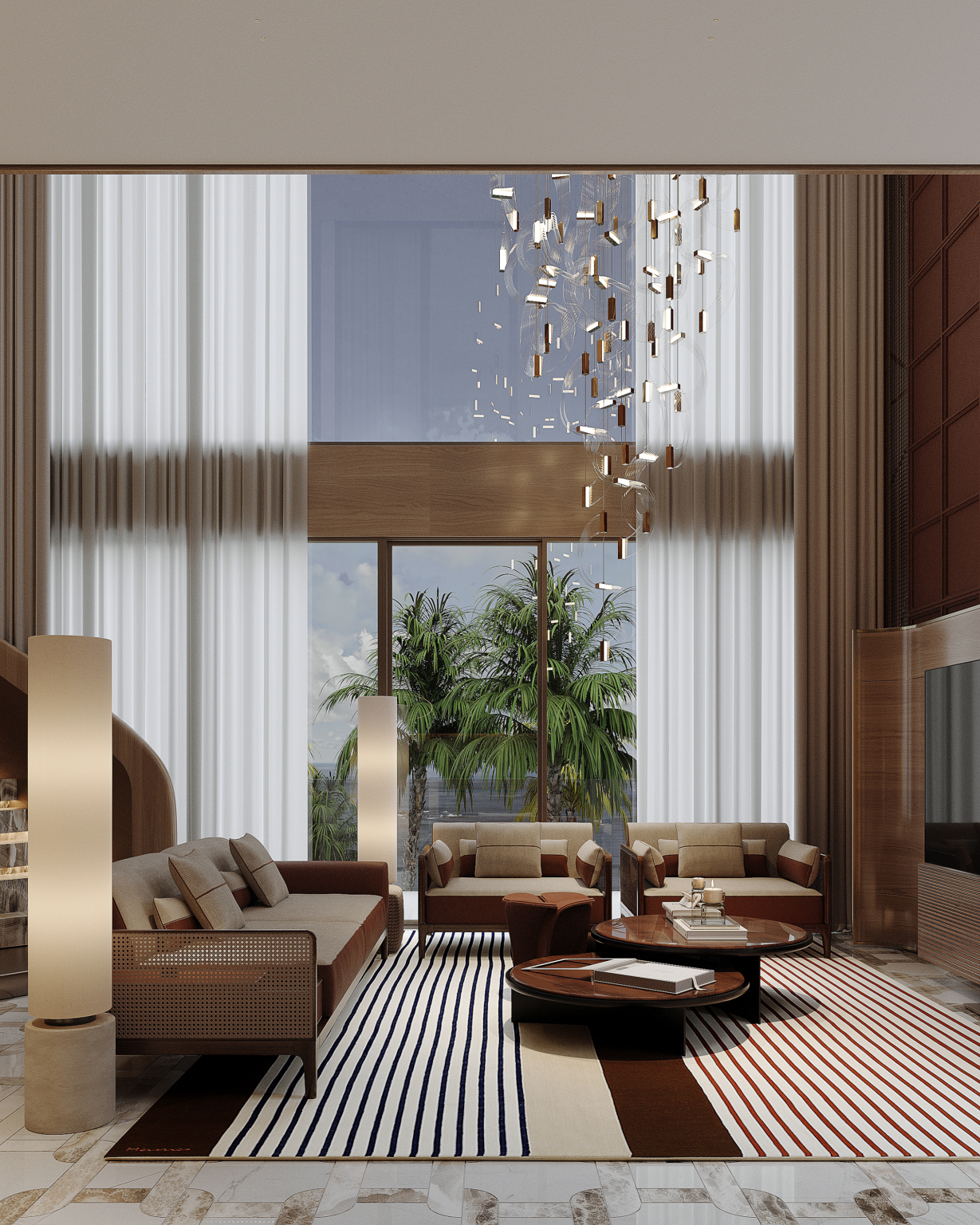
Based on this, we make architectural decisions: room scale, ceiling height, movement routes, and visual axes. We design lighting as a dynamic system, considering the time of day and functional scenarios — it should not be just a set of decorative fixtures.Acoustics are integrated simultaneously with architecture: we work with sound absorption, reflection, and diffusion to avoid monotony or hidden tension. Materials are chosen not only for their appearance but also for their tactile and acoustic properties. What matters is not the saturation of the environment, but its hierarchy and readability.It is fundamentally important that all these solutions exist as a single system. It is this systematic approach that distinguishes neuroarchitectural design from a collection of disparate design techniques.
— How does the role of designer and architect change with this approach?
— We stop being creators of visual images and become responsible for a person’s state within a space. This requires interdisciplinary thinking and letting go of authorial ego. A designer must understand the consequences of their decisions, not just their visual effect.
— How do you see the development of neuroarchitecture in the coming years?
— I see a movement towards deeper personalization and an ethical approach to environmental impact. With the development of analytical tools and digital technologies, space will become more adaptive. But the key issue will remain responsibility — the designer works with people, not objects.
— Your professional conclusion?
— An interior is not a style or a trend. It is an environment that daily shapes a person’s state. And it must be designed consciously.